Notes From the Field: Mozambique

Dr Georgina Heydon has recently returned from field work in Maputo, Mozambique where she was working with her project collaborator, Dr Eliseu Mabasso of the University Eduardo Mondlane in Maputo.
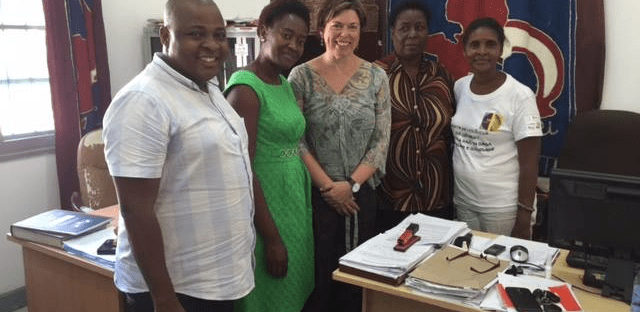
Georgina et al_Maputo_2016

Together, they conducted a series of in depth interviews with agency staff in NGO and government departments with a focus on the investigation of family violence in the formal and informal justice systems in Mozambique.

Towards the end of the trip, she wrote:
______________________________
“Some of you would have loved to be a fly on the wall in the interviews we’ve been conducting here with human rights and women’s support agencies.

Often I feel pretty guilty taking up time to interview people whose clients are sitting out in the baking heat waiting for their appointment.

The stories and experiences are in many ways universal: women are frightened to go to the police, ashamed of their husband’s offending, they go back to the perpetrator, feel powerless to leave etc etc. Depressingly familiar.

However, all of the women we have met in justice agencies have been steadfast in their determination to change things here and help the victim-survivors as best they can.

They are real fighters and appropriately after International Women’s Day yesterday, remind me to never take feminism’s gains for granted.

The photo was taken at the Women’s Association for Law and Development (MULEIDE). Dr Mabasso is on the far left, and I am standing with paralegal staff and counsellors from the agency in front of one of their beautiful hand made banners. We are smiling because the power came back on so they could turn on the computers and the air conditioner and get on with their work.”


It takes a village: law reform can’t be the only response to online child abuse material

By Marg Liddell and Anastasia Powell

The Victorian government introduced legislation this week to deliver on key changes recommended by an in-depth review of the state’s sexual offences.

Among the changes is the replacement of the term “child pornography” with “child abuse material”. This shift in terminology is particularly welcome.

What’s in a name?

It might appear a small change to some. But naming this material to clearly identify the abuse it depicts is important.

Rather than the minimising term “child pornography”, calling these images “child abuse material” makes clear that the images involve child abuse, and that consumers of these images are colluding in child abuse.

However, this shift is not merely semantic. The new laws also extend the definition of child abuse material to include images involving other forms of abuse, regardless of whether or not the image is “sexual”.

This is an important change that brings Victoria into line with several jurisdictions, such as New South Wales, that include depictions of a child as a victim of torture, cruelty or physical abuse in their criminal laws.

New forms of sexual exploitation and abuse

The changes will also bring Victoria’s laws up to date with new forms of exploitation and abuse of children and young people that are associated with communications technologies.

Read the full article on The Conversation, or download the RMIT research report into women’s experiences when they learn a partner or family member is involved in child abuse material

Confidential reporting and written responses in sexual assault cases

By Georgina Heydon and Anastasia Powell

The confidential reporting of sexual assaults can play an important role in support processes for victim-survivors and has the potential to improve the rate of official reporting of sexual assault to police. However, the self-reporting forms currently used for this purpose are not developed in line with the research evidence regarding forensic interviewing techniques, and nor have they been trialled and evaluated for their effective use in sexual assault investigations. This situation leads to substantial inconsistencies between the information gathering practices used by police in formal interviews, and the information gathering practices used in confidential, self-reporting contexts. In this article, we engage in a conceptual and critical consideration of current forms used in response to sexual assault. Ultimately, we propose that a written-response interview protocol (WRIP), has potential to improve the completeness and accuracy of evidence, as well as the consistency and experiences of victim-survivors of sexual assault.

Read the journal article in Policing & Society here.

Gender equality in the workplace can prevent violence against women

By Larissa Sandy and Anastasia Powell

Workplaces can be a key setting to prevent violence against women but prevention programs are often thwarted by some leaders who don’t see it as a workplace issue, our research shows.

Our report focused on 15 workplaces and organisations from the corporate, community sports and recreation, local councils and education settings as well as male-dominated industries, and sought to find out how they are addressing gender inequality.

International research shows that greater inequalities between men and women increase the risk of violence against women. Workplaces can contribute both directly and indirectly to improving gender equity in our community and to building cultures based on respect. It is partly through workplace recruiting, hiring, and pay practices, that Australia still has a gender pay gap of 17.9%.

Sexual harassment, despite being unlawful, is also still a major issue for workplaces. The Australian Human Rights Commission reports that around one in three Australian women experience sexual harassment in their lifetime.

Read more at The Conversation or
Download the research report here.

Cyber justice: how technology is supporting victim-survivors of rape

By Anastasia Powell and Tully O’Neill

We tend to think of “justice” as meaning having one’s day in court – and that justice is done when the perpetrator is convicted and punished. But for many victim-survivors of sexual violence, that day may never come.

While one in five Australian women and one in 22 men will experience sexual violence in their lifetime, most do not report it to police. Even for those who do, conviction is difficult. And the trial process can further add to victims’ trauma.

Research with victim-survivors has also repeatedly found that “justice” itself can mean many things. Some survivors describe “justice” as meaning that their experience is heard and the offender is held responsible for their actions.

Some victims also describe wanting to be able to tell the whole storyabout what happened to them to an audience that believes them and that acknowledges the wrongfulness of the harm done.

Perhaps this is why some survivors are using social media and other online platforms to share their experiences of sexual violence and seek support from a community of peers.

Read more at The Conversation or the journal article in Theoretical Criminology.